Mental model
Five moving parts. The names matter — they show up in every error, log line, and API call.
Everything in Nomos is one of five things. Hold these in your head and the rest of the docs read themselves.
Where you watch it all happen
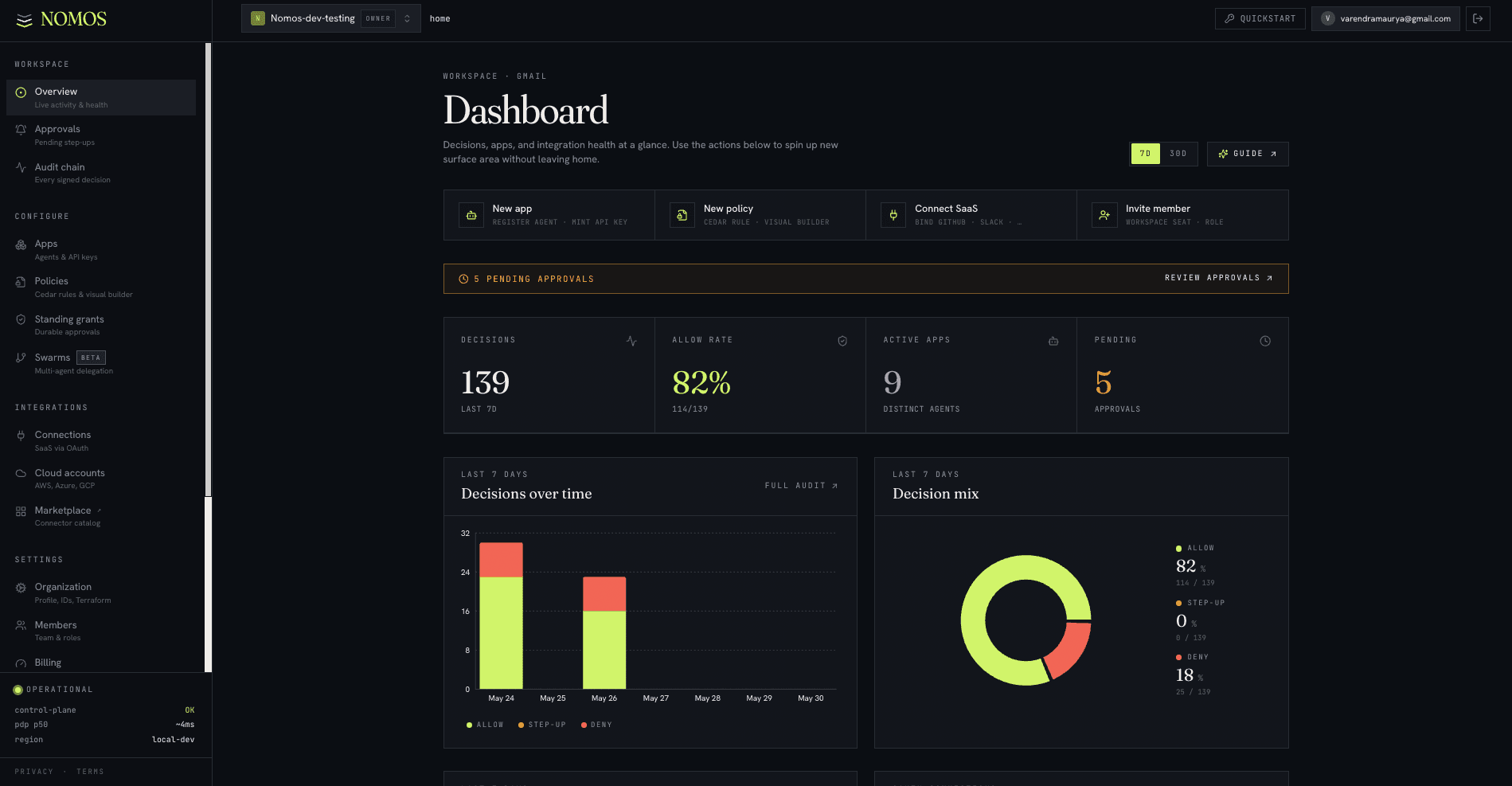
The dashboard Overview is the home for one organization. The top row counts the last 7 days — Decisions (total authorize calls), Allow rate, Active apps, and Pending approvals waiting on a human. Below, Decisions over time bars the allow/deny/step-up split per day, and Decision mix breaks the same totals into a donut. Quick actions across the top — New app, New policy, Connect (an agent), Invite member — jump straight into the flows the rest of these docs walk through.
The five parts
- 1Agent + SDK
Your code. The one that wants to call GitHub, Slack, or your filesystem. It imports
@auto-nomos/sdk(TypeScript) ornomos(Python) and talks to the control plane. It never holds an OAuth token. - 2Control plane
The hosted (or self-hosted) API at
control.auto-nomos.com. Owns the database of apps, connections, policies, and API keys. It mints UCANs — short-lived signed delegations — and hands them to the agent. - 3PDP (Policy Decision Point)
The gate. Every request from the agent goes through the PDP. It checks the UCAN signature, runs your Cedar policy, proxies the call upstream, and returns the sanitized response. Stateless and horizontally scalable.
- 4SaaS API (or filesystem / SSH / cloud)
The thing your agent is actually trying to talk to. The PDP swaps the UCAN for the real OAuth token (held only on the broker side) and makes the upstream call.
- 5Audit chain
Every authorize, every deny, every step-up writes one row. Rows hash-chain to the previous row. A signed root lands once a day. You can prove any single row was in the chain at any point in time.
A request, narrated
- Your agent says "I want to list issues on
acme/app" — the SDK turns that into an/v1/authorizecall to the control plane. - The control plane checks: does this App's policy allow
/github/issue/liston that repo? Yes — it mints a UCAN scoped to exactly that, valid for 5 minutes. - Your agent makes the actual call against the PDP:
GET /github/issue/listwith the UCAN in theAuthorizationheader. - The PDP re-validates the UCAN, decrypts the GitHub OAuth token, calls GitHub, returns the list.
- The audit chain gets one new row:
allow,command=/github/issue/list,app=…,hash=…. The next row will hash this one.
Names you'll see often
Glossary check
These five terms appear in every doc page, error message, and log line. Memorize them now and stop translating later.
- Organization — your team. One database row in
customers. Has members, apps, connections, policies. - App — one agent identity. Has a DID, zero-or-more API keys, exactly one policy, one mode (static or dynamic).
- Connection — one OAuth binding (e.g. your GitHub account). Apps reuse connections; they don't own them.
- Policy — Cedar source. Decides allow / deny / step-up on every request.
- UCAN — the short-lived delegation. JWT-shaped. Carries
iss,aud,att(capabilities),exp. The agent never persists one.